How to Follow Up With Instagram Leads Who Stop Replying
An Instagram follow up sequence for agencies: what to send, when to send it inside the 24-hour window, and when to stop. Templates included.
An Instagram lead who stops replying should get two or three short follow-ups inside Meta’s 24-hour messaging window. Each one changes the angle instead of repeating the offer, and then the sequence stops. The first follow-up resends the hook, the second adds one useful detail and one easy question, and the last one closes the loop politely.
Anything after that waits for a new move from the lead: a fresh comment, a story reply or a new DM. Pushing past the window or past three messages is how a client’s account starts to look like spam.
Most buyers need more than one touch before they decide, and on Instagram that often means a second or third message after the first DM. A lead who goes quiet after the first DM isn’t lost yet, so a well-timed follow-up written for that lead keeps the conversation going until they book or say no.
This playbook is for the agency owner or account manager running Instagram DMs for several clients. By the end you’ll have the timings, the wording, the exit rules and a way to run the same sequence across every client.
What is an Instagram follow-up sequence?
An Instagram follow-up sequence is a short, pre-planned series of DMs sent to a lead who went quiet. Each message is timed and written for the point where that lead stopped.
Skylead defines a follow-up sequence as a pre-planned series of messages and touchpoints sent over a defined period after the first outreach. On Instagram, Meta sets that period, and it’s short.
How long do you have to send a DM follow-up on Instagram?
You have 24 hours from the lead’s last message. Instagram gives you a 24-hour window to send standard messages after a person’s last message to you.
Automation tools work inside the same limit. GoHighLevel’s documentation says automated DMs can only go out within 24 hours of the last user interaction.
Every reply from the lead restarts the clock. When they go silent, every follow-up has to land before those 24 hours are up. Plan the sequence backwards from that deadline, not forwards from whenever your team gets round to it.
Comments run on a different clock. Meta allows one private reply per comment, within 7 days of it. A lead who commented and then ignored the DM can’t be messaged again off that same comment. A new comment on a new post is a new chance.
Where did the lead stop replying?
Someone who never opened your first DM needs a different message from someone who read the price and vanished. Sending both people the same nudge is what makes a sequence feel spammy.
Inrō’s guide puts the first case bluntly: if the DM was never opened, resend the hook, not the offer, and leave the link out. The table below covers the other stop points.
| Where the lead went quiet | What the follow-up does | What to avoid |
|---|---|---|
| Never opened the first DM | Resends the hook, with curiosity and no link | Repeating the offer or the price |
| Read the offer, didn’t answer | Adds one useful detail and one yes/no question | Sending the same offer again |
| Asked the price, then silence | Answers the likely objection: payment, delivery, availability | Discounting on the first nudge |
| Started booking, didn’t finish | Offers two specific times | Asking “still interested?” |
| Booked a slot | Sends a reminder the day before and an hour before | Treating them like a cold lead |
The last row isn’t really re-engagement, but it belongs in the same sequence. Inrō notes that a reminder the day before and an hour before the call cuts no-shows, and a no-show is just a lead who stopped replying at the worst possible moment.
How to build an Instagram follow-up sequence, step by step
Six steps. Do them once per client offer, then reuse them.
Build an Instagram DM follow-up sequence
- Tag where the lead stoppedMark each quiet lead with its stop point: unopened, read offer, asked price, unfinished booking or booked.
- Write follow-up 1Send a few hours after the last message. Resend the hook in one or two lines, no link.
- Write follow-up 2Send before the 24-hour window closes. One useful detail plus one easy question.
- Write the close-outA short, polite last message that makes replying easy and stops the sequence.
- Set exit rulesStop on any reply, a booking or a no. Hand ready buyers to a person with the conversation history.
- Approve and rehearseReview the messages, test them on past conversations, then switch the sequence on.
Step 1: Tag where the lead stopped
A sequence only works if you know which message to send, so every quiet lead needs a stop-point tag. Doing this by hand across five clients falls apart within a week.
In Maxbound, the built-in CRM saves each lead from the conversation and keeps its tags and stage current as the chat goes on. Contacts can be filtered into lists for a follow-up, so “asked price, no reply” becomes a list nobody had to type.
Step 2: Write follow-up 1, a few hours after silence
Follow-up 1 resends the hook. Keep it to one or two lines, lead with curiosity and leave the link out. As an illustration, four hours after the last message works well: late enough not to feel pushy, early enough to leave room inside the window.
Step 3: Write follow-up 2, before the window closes
Follow-up 2 gives one useful detail and asks one question the lead can answer in a word. Send it around 20 hours after their last message, which keeps a margin before the 24-hour cut-off.
Put the important detail in the text itself. Instagram shows link buttons in the mobile app only, so a message that depends on a button breaks for anyone reading on desktop.
Step 4: Write the close-out message
The close-out is the Instagram version of the breakup email from cold outreach. It says you won’t chase, and it makes replying easy.
Then stop. Inrō’s range is one to three follow-ups over a few days, and past that, reply rates fall and people start muting the account. On Instagram, the window usually means two follow-ups plus a close-out at most, unless the lead replies and restarts the clock.
Step 5: Set the exit rules
Exit rules decide when the sequence stops, and they matter more than the wording. Four rules cover almost everything:
-
Any reply stops the sequence and the agent answers the actual message.
-
A booking stops the sequence and starts the reminders.
-
A clear no stops everything and tags the lead as lost.
-
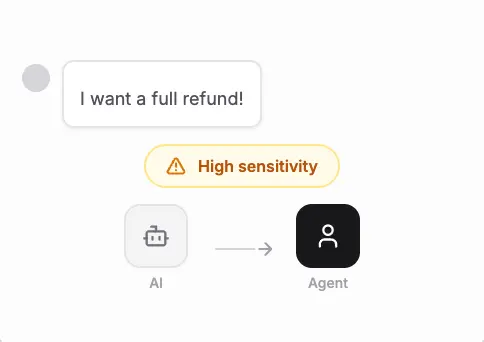
A ready buyer, or anything the agent shouldn’t handle, goes to a person on the client’s team with the full conversation history.
Step 6: Approve and rehearse before it goes live
Never switch a sequence on unread. Someone at the agency should read every message in context, against the client’s real leads.
In Maxbound, nothing goes live until someone on the team approves it, and that approval can stay on for as long as you want. You can also set the agent to draft each reply for a person to approve or edit before it sends, which is the safe way to run the first week on a new client.
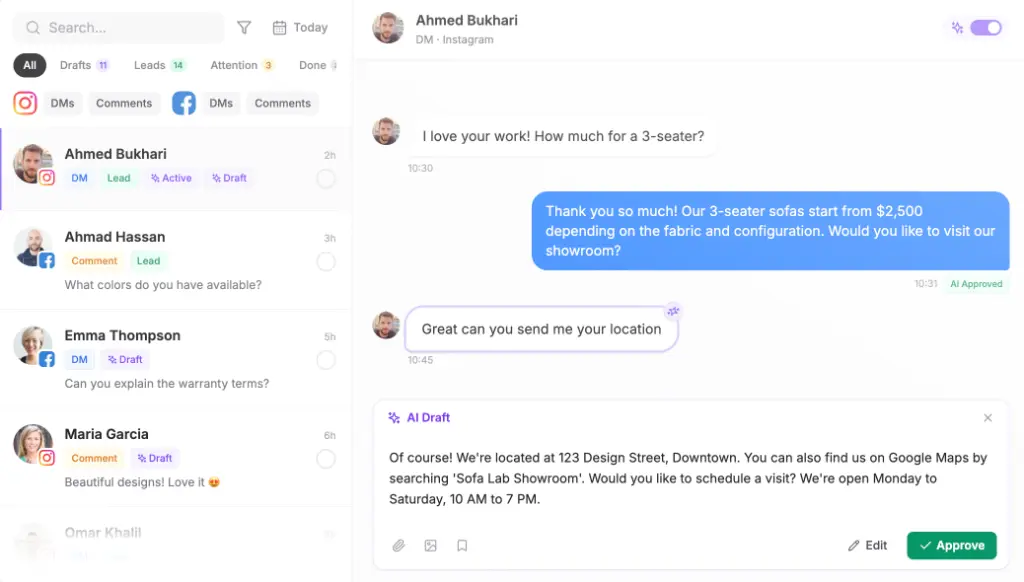
Before it answers anyone, rehearse the agent on real past conversations so you can see how it handles the leads who went quiet last month.
Follow-up message Instagram templates to copy
These are written for an illustrative client: a dental clinic running a teeth-whitening post. Swap in your client’s offer and keep the structure.
Follow-up 1 (unopened, about 4 hours later):
Quick one: most people who ask about whitening want to know how many shades lighter it actually gets. Want me to send a real before-and-after?
Follow-up 2 (read, no reply, about 20 hours later):
One thing people often miss: the session takes about an hour and you can go straight back to work. Would a weekday or a weekend slot suit you better?
Close-out (last message in the window):
I won’t keep messaging. If you want a slot later, just reply “whitening” here and we’ll pick it up.
Booked reminder (day before, then an hour before):
See you tomorrow at 4pm. Reply here if you need to move it.
Notice what each message does. One idea, one question, no repeated offer, and the close-out gives the lead a one-word way back in.
How do you run DM follow-ups for every client in Maxbound?
In Maxbound, you brief the follow-up in plain language, the way you’d brief a new hire, and the agent builds it in that client’s workspace. You can do this inside Maxbound or from Claude, ChatGPT or Codex through Maxbound’s MCP server.
A brief for the clinic might read: “When someone asks about whitening and goes quiet, follow up after 4 hours with the before-and-after hook, then once more before the 24 hours run out with the session length and a weekday-or-weekend question. Stop if they reply, book or say no. Send anyone asking about pain or medical history to the front desk.”
The agent then asks what it needs to know, such as who owns the bookings and what counts as a no. It builds the sequence and waits for approval. Follow-ups written for each lead keep going until the lead books or says no, and bookings are taken right in the chat.
The front of the funnel lives in the same workspace. Comment-to-DM turns public comments into private DMs and saved contacts, each post can carry its own DM in varied wording, and the follow-up picks up from there.
Two behaviours stop the sequence from tripping over your team. When someone on the team replies, the agent steps back, so the lead never gets two answers. The agent also waits a few seconds before replying, so a burst of messages gets one answer.
Every client gets its own workspace, with its own channels, knowledge, contacts and agents, and nothing crosses between clients. Your team still sees every client’s Instagram, WhatsApp, Facebook and website chats in one inbox.
Once a sequence works for one clinic, clone that workspace as the starting point for the next. For lead generation agencies handing buyers to clients, that means the second, third and tenth client start from a sequence you already trust.
What are the common DM follow-up mistakes?
Most broken sequences fail in one of five ways:
-
Too many messages. A fourth nudge trains people to mute the client’s account.
-
One message for every stop point. An unopened DM and a price objection need different follow-ups.
-
Link-only messages. Buttons don’t show on desktop, so the message reads as empty.
-
Chasing someone your team is already talking to. Without a guard against double replies, the lead gets an automated nudge mid-conversation.
-
No exit on “no”. Messaging someone who declined is the fastest way to a report.
When should you not automate the follow-up?
Some leads shouldn’t get an automated sequence at all. If a client sells something high-ticket or sensitive, such as a medical treatment, keep the agent on drafts so a person sends every word.
Leads who complained, or whose messages read as angry, should go to a person straight away. A cheerful nudge to an upset customer makes things worse.
Leads outside the 24-hour window shouldn’t be chased with workarounds. Wait for them to comment, reply to a story or message again, then answer fast. If your team needs a refresher on that first reply, here’s how to reply on instagram dm and to comments by DM.
One limit, said plainly: Maxbound follows up in the conversation channels it runs, which are WhatsApp, Instagram, Facebook Messenger, website chat and in-app chat. It doesn’t follow up by SMS or voice.
Pick one client, tag last week’s quiet leads by stop point, and brief the sequence. Every workspace comes with a 7-day free trial, so you can run it on real conversations, with approval on, before you decide.