Busting the Myths of Instagram DM Automation Tools
Four myths keep agencies answering Instagram DMs by hand: that customers hate automation, that it's all-or-nothing, that setup takes weeks, and that it gets
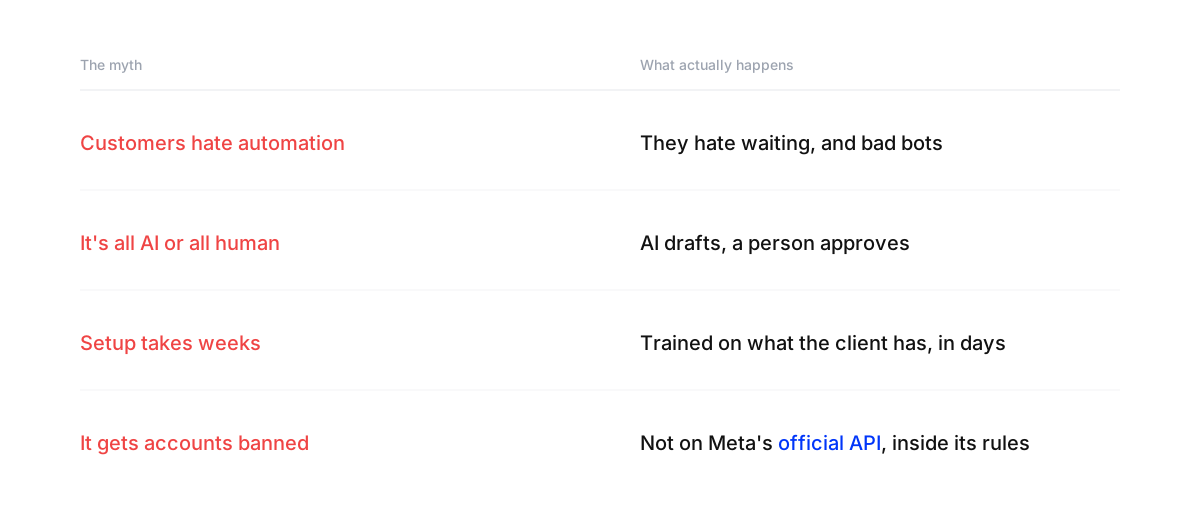
Four myths keep agencies answering clients’ Instagram DMs by hand: that customers hate automation, that you must choose between all-AI and all-human, that setup takes weeks, and that automation gets accounts banned. Each has a grain of truth, and each falls apart once you look at how a good tool actually works.
The short version: customers dislike slow and useless replies, not automation. You can run AI with a person approving every reply. A tool trained on the client’s own website and past conversations can be live in days. And automation through Meta’s official API, inside Meta’s rules, is what the API was built for.

Myth 1: Customers hate automation
What people dislike is waiting, and bots that can’t answer the question. Someone asking about price, size or delivery wants the answer now, not tomorrow, and not a menu of buttons.
The waiting is the bigger problem. When we read 1,788 public comments on the Instagram and Facebook posts of 178 businesses, the businesses had answered 15% of them in the thread, and when they did answer, the typical wait was 2 hours 42 minutes (Maxbound comment response study). An instant, correct answer beats both.
What does put people off is the old keyword bot: it only understands the exact word it was set up for, so “do you ship to Abu Dhabi and how long?” gets a link to the homepage. An agent trained on the business reads the question and answers it.
Myth 2: It’s all AI or all human
Most teams start in between. The AI drafts every reply and a person approves, edits or takes over, so nothing goes out unchecked. As the drafts stop needing edits, routine answers are allowed to go out on their own, while complaints, refunds and anything sensitive keep going to a person.
This isn’t a permanent stage. The point of approving drafts is to find out, on the client’s real messages, which answers the AI gets right every time. How to run it is in setting up a human-in-the-loop workflow.
Myth 3: Setup takes weeks of programming
That was true of flow builders, where every question needs its own branch. An agent works differently: it’s trained on what the business already has, such as its website, price list, policies, FAQs and past conversations (knowledge training), and answers questions nobody wrote a branch for.
The work that remains is checking it. Run the agent on a week of the client’s real past messages without sending anything, fix every wrong answer at its source, then go live with approval on. For most clients, that’s days, not weeks.
Myth 4: Automation gets the account banned
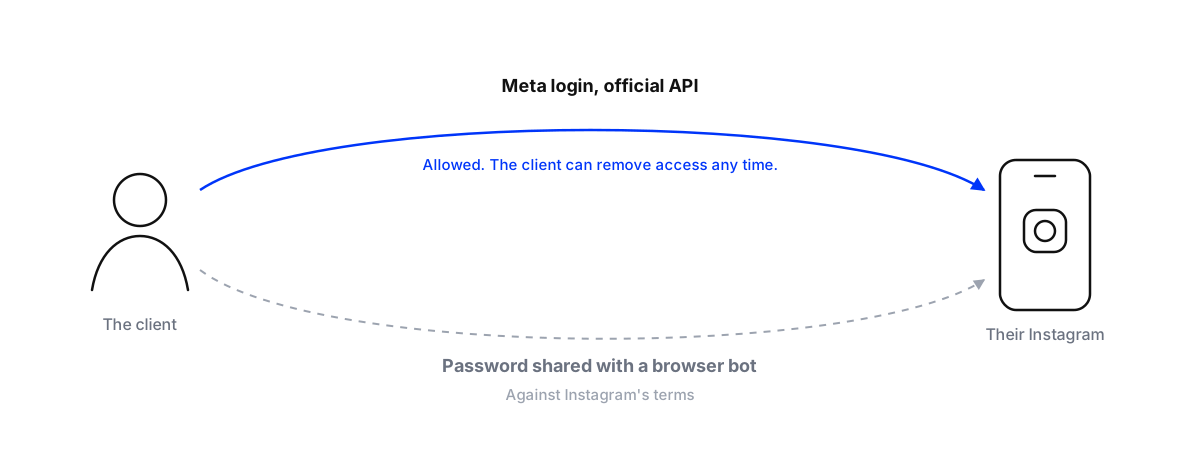
How the tool connects is what matters. Instagram’s terms forbid collecting information “in an automated way without our express permission”, which is what password-sharing tools and browser bots do. A tool on Meta’s official API is the permission: the client connects through Meta’s own login and can remove access at any time.
Even official tools work inside limits. Meta allows one private reply to each comment, sent within seven days, and more messages only if the person writes back. A tool that respects those rules, and sends messages people asked for, isn’t the kind of account Meta acts against. Spammy messages people report are.
What automation still shouldn’t do
Busting the myths doesn’t mean automating everything. Some things stay with a person, whatever the tool:
- Complaints and refunds. An apology and a decision about money need someone accountable. The agent can acknowledge the message and pass it on with the thread.
- Promises the client hasn’t made. Discounts, delivery dates it can’t check, exceptions to a policy. If it isn’t in the client’s material, the agent should say a person will confirm.
- Messages nobody asked for. A DM should follow something the person did, such as a comment asking for the link or a question they sent. Cold messages are what get reported.
- Anything medical, legal or about safety. Straight to a person.
Writing these down per client takes ten minutes and prevents most of the problems people blame on automation.
How to tell a good tool from a risky one
Ask five questions before connecting any client:
- How does it connect? Meta’s login and official API, never a password or a browser extension.
- Does it answer questions or match keywords? Test it with an awkward real message from last month.
- Can a person approve replies first? And take over a conversation with the thread in front of them?
- Where do leads go? Saved as contacts the client can use, not lost in a chat log.
- Is each client kept separate? Its own knowledge, voice and report, so one client’s prices never turn up in another’s replies, and you can show each client its own results.
For a fuller comparison, read the best way to automate Instagram and Facebook replies.
Where Maxbound fits
Maxbound is an approved Meta Tech Provider, and its Instagram automation runs only on Meta’s official APIs. An AI agent per client, trained on that client’s own material, answers comments and DMs, moves buying questions into a private message, saves the person as a contact and hands sensitive conversations to your team. Every reply can wait for approval until you trust it. Agencies run each client in its own workspace; see Maxbound for marketing agencies, or book a demo to see it on your own inbox.