
How to Cut the Cost of Social Media Customer Service
Social media customer service gets cheaper by lowering the cost of each conversation, not by cutting people. One number to track and five levers that move it,
Social media customer service gets cheaper when each conversation costs less, not when there are fewer people. Track one number, cost per conversation, and move it with five levers: an AI agent for the questions that repeat, handoffs that carry the whole conversation, answers people can find without asking, one inbox for every channel, and staff hours that match when messages actually arrive.
For an agency this matters twice. Support volume often sits inside a fixed retainer, so when a client’s messages double and the fee doesn’t, the margin takes the hit. Hiring to keep up just moves the problem: the cost per conversation stays where it was.

The one number: cost per conversation
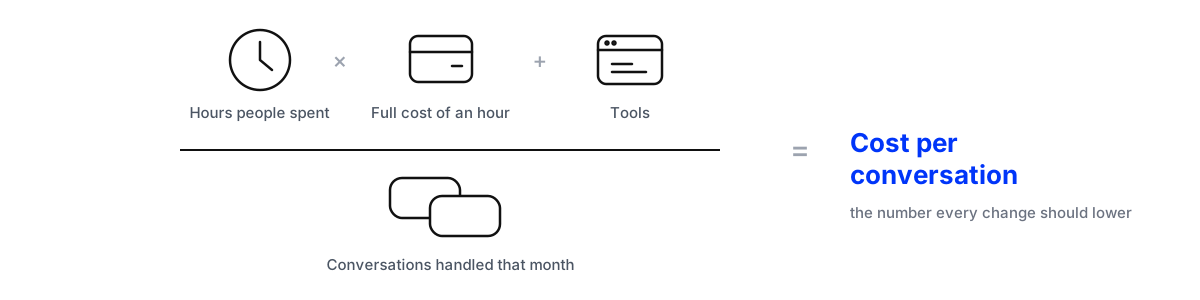
Add up a month of support: the hours people spent answering, at their full cost (pay plus the overheads that come with it), plus the tools. Divide by the conversations handled that month. Work it out per client and per channel if you can, because a WhatsApp conversation and an Instagram comment rarely take the same effort.
Then work out the same number again after each change. If it doesn’t fall, the change didn’t save anything, whatever it felt like.
A made-up example to show the arithmetic: a client’s month took 120 hours of answering at a full cost of $25 an hour, plus $300 of tools. That’s $3,300. If 2,200 conversations were handled, each cost $1.50. Next month, with an agent answering the routine questions, people spend 60 hours and the tools cost $500: $2,000 for the same 2,200 conversations, about $0.91 each. Your own numbers will differ; the method doesn’t.
Lever 1: let an agent answer the repeats
Most inboxes are full of the same questions: price, stock, opening hours, delivery, how to book. Each takes a person a minute or two, all day. An AI agent trained on the client’s facts answers these in seconds, at any hour, so people spend their time on the conversations that need them. Start with replies a person approves, then let the routine ones go out alone.
Lever 2: hand over with the whole conversation
Every time a customer has to repeat themselves, the conversation takes longer and costs more. When the agent passes a conversation to a person, it should come with the thread and the reason, so the person picks up where it stopped. See smart escalations.
Lever 3: answer before people ask
A question that’s answered on the page, in the post or in the first comment never becomes a conversation. Put delivery times and prices where people decide, pin a comment with the answer under busy posts, and set up Instagram’s frequently asked questions in DMs. The cheapest conversation is the one that doesn’t happen. Look at the questions your agent answers most each week: any that keep coming back are telling you what the page or the post forgot to say.
Lever 4: one inbox for every channel
Switching between Instagram, Facebook, WhatsApp and website chat costs time and loses context. One inbox per client, with every channel in it, means one queue, one history per customer and nothing missed in an app nobody opened. See the omnichannel inbox.
Lever 5: staff for when messages actually arrive
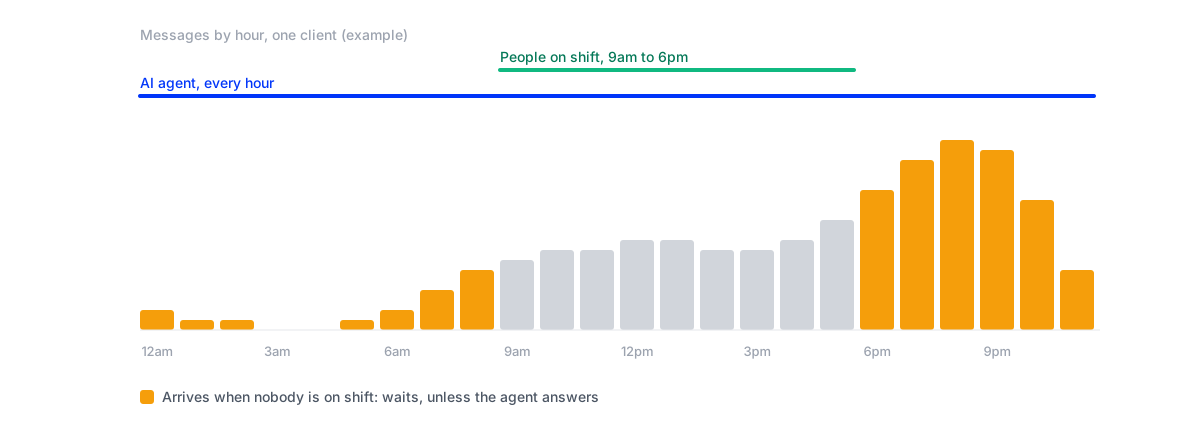
Most teams are staffed for office hours, and many messages aren’t sent then. In our study of 1,788 comments on 178 businesses’ Instagram and Facebook posts, 53% of the comments nobody answered arrived outside 9am to 6pm (Maxbound comment response study). Count a client’s messages by hour for two weeks, then put people where the volume is, and let the agent cover the hours nobody is on.
What changes, all together
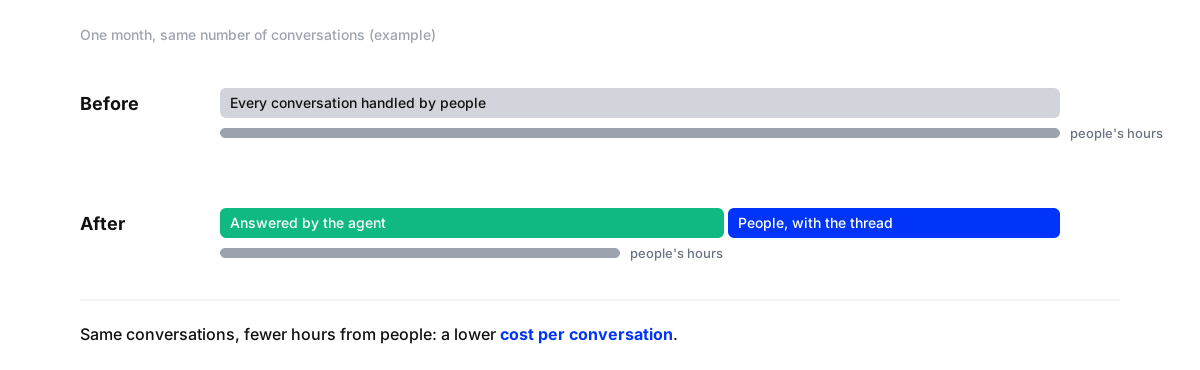
Put the levers together and the same month looks different: the agent handles the routine questions, people handle fewer conversations but the ones that need them, and the hours they spend fall while the number of conversations stays the same or grows. That is a lower cost per conversation, and for an agency, a retainer that still pays when the client gets busier.
Cut a client's cost per conversation
- Measure the baselineOne month: hours people spent, their full cost, tools, and conversations handled. Divide to get cost per conversation.
- Count by hour and by questionWhen messages arrive, and which questions repeat most.
- Answer the repeats firstTrain an agent on the client's facts, run it with approval, then let routine answers go out alone.
- Fix handoffs and channelsHand over with the whole thread, and bring every channel into one inbox.
- Move hours to the volumeStaff the busy hours, and let the agent cover the rest.
- Measure againRecalculate cost per conversation after each change, one change at a time, so you know which one worked.
What not to cut
A lower cost per conversation is only a saving if the answers stay right. Three things are worth protecting even when the budget is tight. The weekly review of the agent’s answers, because a wrong price or promise repeated a hundred times costs more than any saving. Complaint handling by a person, because a badly handled complaint in public costs the client customers. And the time it takes to answer, because a cheap reply that arrives the next morning has already lost the sale.
For agencies: let the retainer follow the volume
If a client’s support sits inside a fixed retainer, a busy month eats the margin. Agree volume bands in the retainer instead: a range of conversations a month that the fee covers, and what happens above it. With the cost per conversation measured, you can show the client exactly why, and with the routine questions answered by an agent, a busier month costs you far less than it used to.
Where Maxbound fits
Maxbound is an AI operating system for agencies. Its AI agents answer comments and DMs on Instagram and Facebook, plus WhatsApp, website chat and in-app chat, trained on each client’s own material, and hand conversations to your team with the thread in one inbox. They learn each brand’s voice from your edits (self-improving AI), and the analytics show what the agent handled for each client. Sentiment analysis sorts urgent and upset messages to the top. For choosing tools, see social media customer service software for agencies; for the agency side, scaling retainers without hiring.