How to Scale Agency Retainers Without Hiring More Staff
An agency grows without hiring when each person can carry more clients without the work slipping: a narrower offer, the repeat work automated, retainers priced
An agency grows its retainers without hiring when each person can look after more clients without the work getting worse. Four moves do most of it: offer fewer services and do them the same way for every client, hand the repeat work, such as answering routine comments and DMs, to an AI agent, price retainers on what the client gets rather than the hours, and keep people on the parts clients actually pay for: judgement, ideas and the relationship.
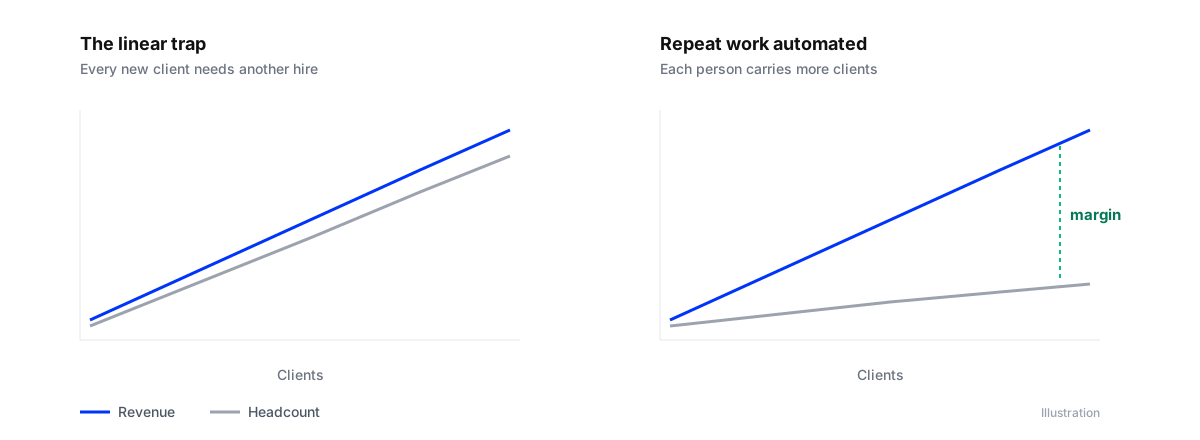
The trap it avoids is linear growth, where every new client means another hire, so revenue and payroll rise together and the margin never moves.
Move 1: offer less, the same way
Narrow agencies grow faster. Promethean Research found that agencies which reduced their service offerings grew 13% in 2025, almost twice the 7.5% average.
A narrow offer can be run as a system: the same onboarding, the same setup, the same report, so a new client adds work but not new ways of working. That’s what lets one account manager carry more clients.
Which services to drop? Start with the ones that never repeat: one-off projects that need a new process every time, small add-ons sold at a discount to win the retainer, and anything only one person in the agency knows how to do. Each of these is fine on its own; together they’re why every client looks different and nobody can cover for anybody.
Move 2: hand the repeat work to an agent
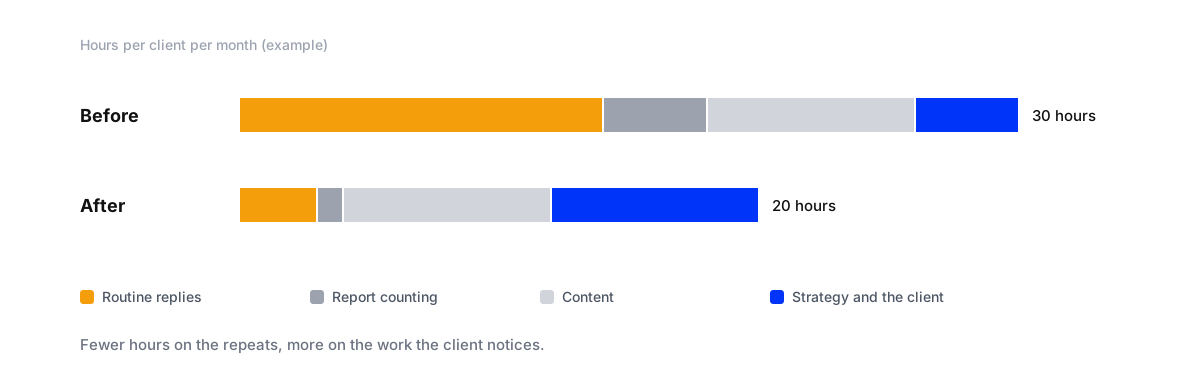
Look at where your team’s hours go in a month. Much of community management is the same questions answered again and again, plus counting for reports. Both can be handed over: an AI agent trained on each client’s facts answers routine comments and DMs at any hour and moves buying questions into private messages, while the numbers for the report come from the same system. People review, handle what the agent passes on, and spend the freed hours on strategy and the client.
The comments are worth answering, not just cheaper to answer. In our study of 1,788 public comments on 178 businesses’ Instagram and Facebook posts, 14% of the comments nobody answered were someone asking to buy (Maxbound comment response study). An agent turns those into leads, which gives the retainer something new to show; see how to turn social media comments into sales.
Move 3: price on outcomes and volume
Hourly or effort-based retainers punish efficiency: the better your systems, the less you can bill. Price on what the client gets instead: messages answered, leads saved, bookings, a report they can read in two minutes. Add volume bands so a busy month above the band is paid for. Value-based pricing is harder to set than it looks; Promethean found its use fell from 37% of agencies in 2022 to 18% in 2025. Outcome-based packages with clear bands are the practical middle ground.
Move 4: one setup per client, repeated
Every client gets the same structure: their own workspace, their facts and voice, the same rules for what goes to a person, the same weekly review and the same monthly report. When the structure is the same, a teammate can cover a client they don’t usually run, and a new client is set up in days. Write the structure down once, as a checklist for onboarding and a template for the monthly report, and improve it every time a client teaches you something. The checklist becomes the agency’s way of working, and a new hire learns it in a week instead of absorbing it over months.
Grow retainers without adding headcount
- Measure hours per clientFor one month, log where each account manager's hours go: replies, reporting, content, strategy, client calls.
- Narrow the offerDrop the services that don't repeat well, and write down how the rest is delivered, step by step.
- Automate the repeatsPut an AI agent on routine comments and DMs for one client, with approval first, and let the reports build themselves from the same numbers.
- Re-price on outcomesAt renewal, package the retainer around results and volume bands, not hours.
- Roll the setup outApply the same structure to every client, one at a time, and measure hours per client again.
An account manager’s week, after
Before, most of the week went on the inbox: answering the same questions for each client, checking every channel, catching up on the evenings and weekends. After, the agent has answered the routine questions overnight, and the week starts with a short list: conversations it handed over, drafts waiting for approval on the sensitive accounts, and anything unusual from the weekend. The rest of the week goes on the work that wins renewals: next month’s content, a call with each client, and fixing what the review turned up, such as a fact the agent was missing.
Signs you can take on more clients
Hours per client have fallen and stayed down for two months. The weekly review takes about the same time however busy the client was. Nothing slipped: no rise in complaints, no late reports, no unanswered messages found by a client before you found them. When all three hold, the next client can go to the same team.
Keep people where clients feel them
Automation should take away the work clients never see, not the attention they do. Keep a person on complaints, on anything the client would be embarrassed by, on the monthly conversation and on new ideas. Clients renew because of the people they talk to; the agent makes sure those people have time to talk to them. Replies can stay approval-first for as long as a client wants, and the agent learns each brand’s voice from your team’s edits (self-improving AI).
Where Maxbound fits
Maxbound is an AI operating system for agencies: one workspace per client where AI agents answer comments and DMs on Instagram and Facebook, plus WhatsApp, website chat and in-app chat, move buying questions into private messages and save the leads (comment to DM to CRM), with an inbox your team works from and a per-client report. More on how agencies use it on the marketing agencies page, or start on the Maxbound homepage.