How to Sell AI Agents Under Your Own Brand
How an agency sells AI agents as its own service: a narrow offer clients understand, white-label delivery, how to price it, a 30-day launch, and the monthly
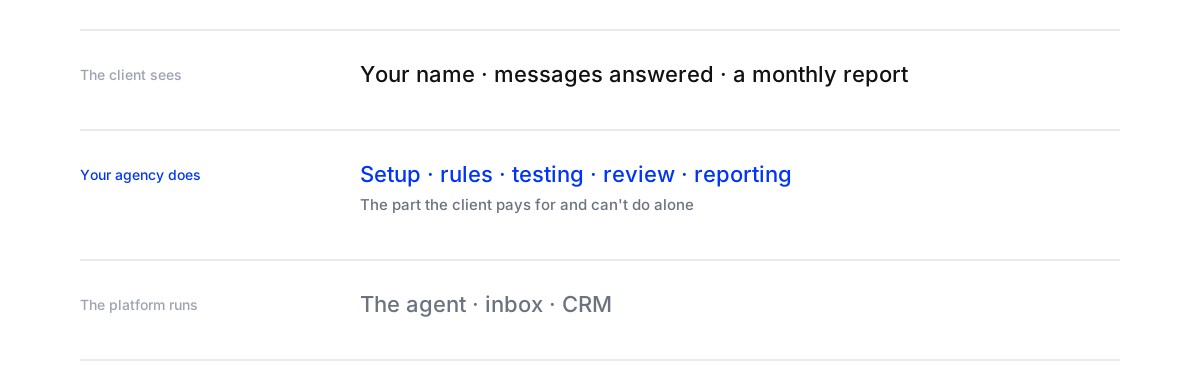
To sell AI agents under your own brand, sell an outcome rather than software: “every message from your customers answered within minutes, day and night, and every buyer saved as a lead”. Deliver it on a white-label platform so the client sees your name, charge a setup fee and a monthly fee per client, and keep the monthly review and report for yourself, because that’s the part the client values and can’t do alone.
Start narrow. One channel, one kind of question, one kind of client. A narrow offer is easier to explain, easier to deliver well, and easier to prove.
Why sell it as your service
Referring clients to a tool gets you a thank-you, sometimes a commission, and nothing to manage. Selling the outcome as a service keeps the relationship and the retainer with you. It also matches what most clients want: they don’t want another login, they want messages answered and to be told it’s working.
And the agent is the smaller part of the work. MIT Sloan reports researchers finding that 80% of the work in an AI agent project goes into data engineering, governance and integrating it into how work actually happens. For a client, that’s gathering their facts, deciding what the agent may and may not answer, testing it, and reviewing it every month. That’s the service, and it’s what you’re paid for.
What to sell first
The easiest first offer is answering a client’s comments and DMs. It’s visible, it’s easy to measure, and most businesses are bad at it. In our study of 1,788 public comments on 178 businesses’ Instagram and Facebook posts, 15% were answered in the thread, and 53% of the unanswered ones arrived outside office hours (Maxbound comment response study). Marketing and advertising agencies answered 6% of the comments on their own posts, so check your own before the pitch.
The pitch then writes itself: show a prospect their own last ten posts, count the unanswered questions, and point out which arrived at night. Then offer to fix it.
What not to sell first: anything regulated, such as medical or financial advice, a promise that the agent will run with nobody checking it, or a client whose messages are mostly complaints. Each is possible later. None is the place to learn.
The questions clients will ask
Expect the same four, and have plain answers ready before the meeting.
“What if it says something wrong?” It starts by drafting replies that your team approves, it answers only from the facts the client gave, and anything it isn’t sure about, or anything sensitive, goes to a person. You’ll show them the test results on their own past messages before anything goes live.
“Can we switch it off?” Yes. The agent can be turned off, the conversations stay in the inbox, and a person can take over any thread at any moment.
“Where does our data go?” Say which platform holds it, how connections are made (through each platform’s own login, never their passwords), and what you’ll do with it. Have the platform’s security page ready to send.
“How will we know it’s working?” The week 1 audit and the monthly report, with the same three numbers every time.
Who on your team runs it
Give each client one owner, usually the account manager who already knows them. They review the agent’s drafts in the first weeks, update its knowledge when the client changes something, and write the monthly report. Once the first weeks are over, it becomes part of the account manager’s routine rather than a new role, which is what makes the margin work.
How to price it
Avoid charging per message: the client can’t predict it and it makes every reply feel like a cost. Most agencies use two parts:
- A setup fee, for gathering the client’s facts, writing the rules, testing on their past messages and the first weeks of approved drafts.
- A monthly fee per client, covering the agent, the monthly review of its answers, keeping its knowledge up to date, and the report.
Price against what the client would otherwise pay a person to cover evenings and weekends, and against the leads currently going unanswered, not against the cost of the platform. Check your own platform costs per client on its pricing page so the margin holds as clients grow.
Your first 30 days with a client

Launch an AI agent service for a new client
- Week 1: audit and set upCount a week of comments and DMs and how many went unanswered. Connect the client's channels through the official logins and load their website, prices, policies and recent conversations.
- Week 2: drafts with approvalThe agent drafts every reply; your team approves or edits. Agree with the client what always goes to a person.
- Week 3: routine answers go liveLet the agent answer the questions it gets right every time, and keep reviewing the rest.
- Week 4: the first reportMessages answered, how fast, leads saved, and what changes next month. Compare it with the week 1 audit.
The week 1 audit is what makes the week 4 report convincing: the client sees the before and after on their own account.
Keep the retainer
What keeps clients is the monthly work they can see: a short report that leads with outcomes, a few real conversations, and the changes you made. Update the agent when prices, products or policies change. Read a sample of its answers every week. The day a client stops seeing your hand in it is the day they start to wonder what the fee is for. More on growing this across clients in scaling agency retainers without hiring.
Where Maxbound fits
Maxbound is an AI operating system for agencies. Its AI agents answer a client’s comments and DMs on Instagram and Facebook, plus WhatsApp, website chat and in-app chat, trained on that client’s own material, with a person approving replies until you trust them. Each client is its own workspace with its own report. White-labelling, and removing “Powered by Maxbound”, are included on every plan; see pricing, and ask us what branding covers for your setup. More for agencies on the marketing agencies page.