
Self-Improving AI That Learns Your Brand Voice
How an AI agent learns a brand's voice from the replies your team approves and edits, how to edit so it learns the right thing, and how to tell it is improving.
A self-improving AI agent learns a brand’s voice from the replies your team approves and edits. Each approval tells it that answer was right. Each edit is a correction it remembers: this word, not that one; shorter; warmer; ask before quoting the price. Over a few weeks of review, its drafts need fewer edits, and that falling edit count is how you know it’s learning.
It isn’t the AI training itself on the open internet or rewriting its own rules unsupervised. It learns from your people, inside one client’s workspace, and only from replies someone looked at.
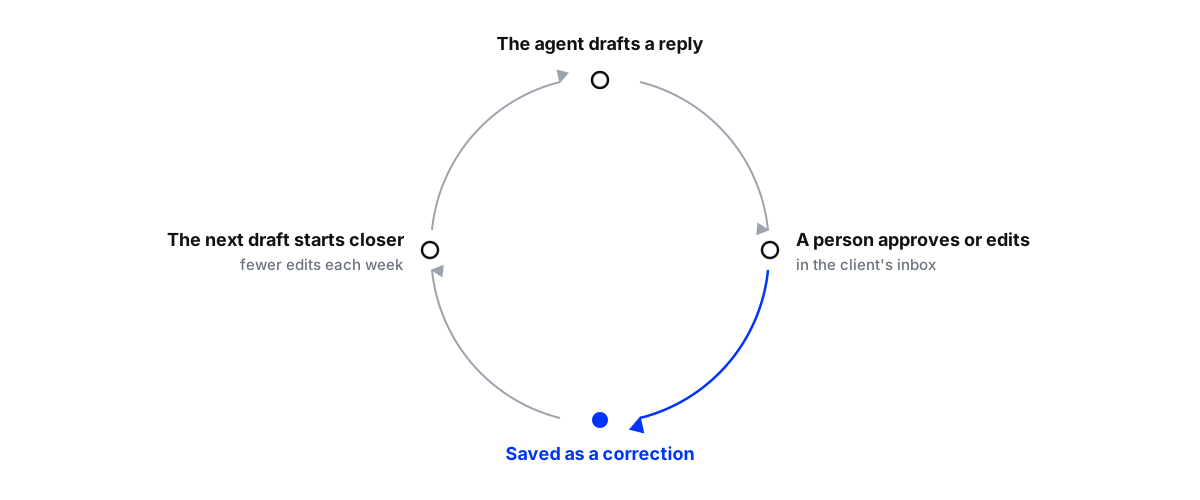
What it learns from an edit
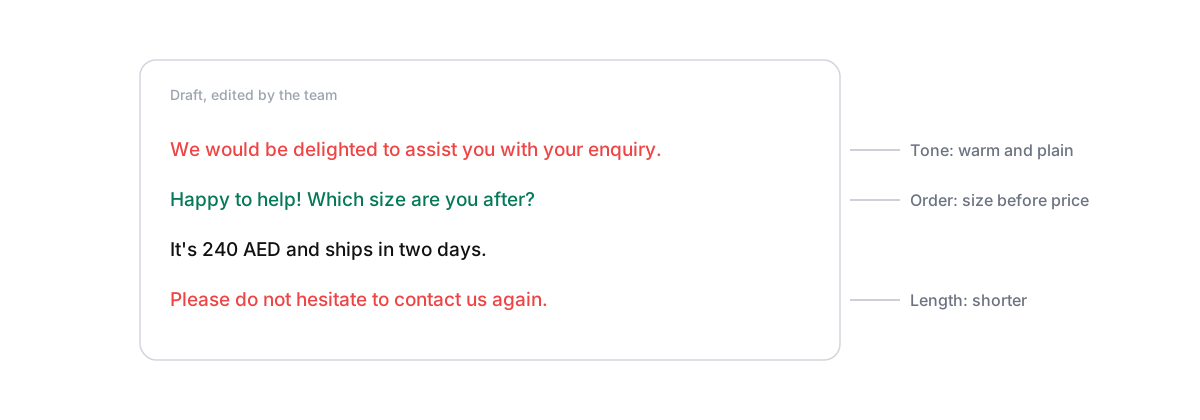
A single edit can teach several things at once:
- Tone. “We would be delighted to assist” becomes “Happy to help”. The agent learns the client is warm and plain, not formal.
- Length. A three-sentence answer cut to one teaches that this client keeps it short.
- Order. Moving “which size?” before the price teaches the team’s sales habit.
- Words to use and avoid. A brand that says “pieces”, not “products”, or never says “cheap”.
- Facts. If the edit corrects a price or a delivery time, the fact gets fixed, not just the wording.
Edit so it learns the right thing
The agent learns from what you change, so a few habits make the learning cleaner:
- Fix the source when it’s a fact. If a price is wrong, update the price list too. An edit fixes one reply; the source fixes all of them.
- Don’t edit for the sake of it. If the draft is right but not how you’d have phrased it, approve it. Rewriting good answers teaches the agent nothing useful.
- Leave one-offs out of it. If you’re giving one customer a favour, such as an extra discount, take over the conversation rather than editing the draft, so the agent doesn’t learn the favour as policy.
- Be consistent across the team. Two people editing the same client in opposite directions will confuse it. Agree the voice first.
What it shouldn’t pick up
Learning from people means it can learn their bad habits too. Watch for:
- A rushed reviewer. Someone approving drafts on their phone between meetings teaches “good enough”. Review in a quiet slot each day.
- A customer’s tone. An angry or rude message should never shape how the brand replies. The agent should answer calmly, and complaints should go to a person anyway.
- Typos and shortcuts. If a teammate writes “u” and “pls” in an edit, the agent may copy it. Edit in the brand’s voice, not your own texting style.
- Out-of-date facts. An edit made before a price change will still look right to the agent afterwards. When something changes, update the knowledge the same day.
Comments and DMs sound different
The same brand speaks differently in public and in private. A reply under a post is read by everyone scrolling: short, friendly, and with no personal details. A DM is one person: it can be warmer, longer and specific about their order, size or booking. Say so in the voice sheet, and review both kinds of reply in the first weeks, so the agent learns each register instead of averaging them.
Start with a short voice sheet
Learning from edits is faster with a starting point. Before going live, write half a page for each client:
- Three words for how they sound, such as warm, direct, playful.
- Words they use, and words they never use.
- How long a reply usually is.
- Emojis: which ones, if any.
- How they apologise, and how they sign off.
Add it to the client’s knowledge with their website, documents and past conversations. If you’re training on history too, see how to train an AI agent on your past conversations.
How to tell it’s working
Watch one number per client: the share of drafts approved without changes. It should rise week by week for the first month and then level off. If it doesn’t rise, look at the edits. The same correction made again and again means a fact is missing from the knowledge or the voice sheet is unclear.
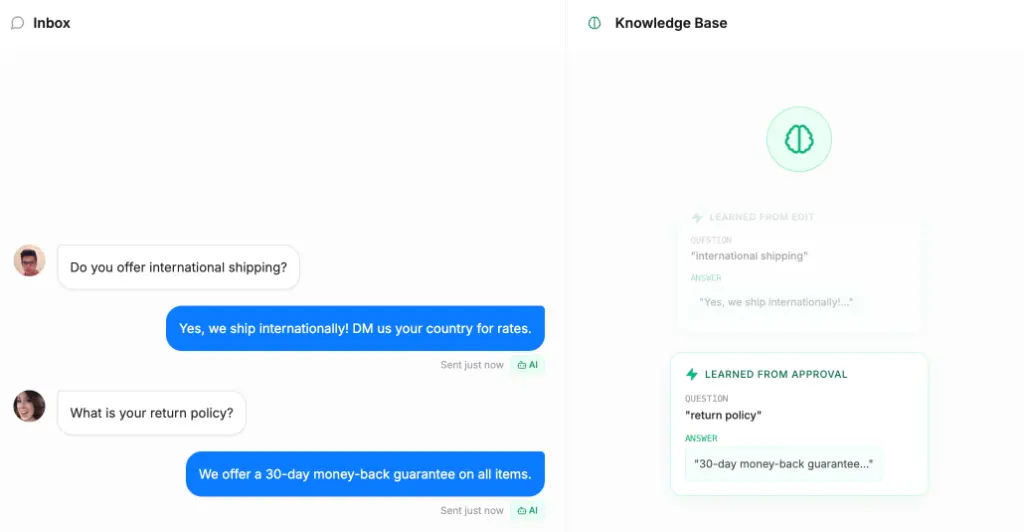
Once drafts are consistently approved unchanged for a type of question, let those answers send on their own and keep reviewing the rest. That’s the path described in setting up a human-in-the-loop workflow. Complaints and anything sensitive keep going to a person (smart escalations).
Teach an AI agent a client's brand voice
- Write the voice sheetThree words for how they sound, words to use and avoid, reply length, emojis, apologies and sign-off.
- Add it to the knowledgeTogether with the client's website, documents and recent past conversations.
- Review every draft for two weeksApprove good drafts as they are. Edit only what's wrong, and fix facts at their source.
- Watch the unchanged approvalsTrack the share of drafts approved without changes each week. It should rise.
- Hand over one topic at a timeLet the agent send on its own for topics where drafts are consistently right, and keep reviewing the rest.
One voice per client
For an agency, the voice must stay with its client. A clinic, a streetwear brand and a law firm should never borrow each other’s tone, so each client needs its own agent, knowledge and learning. It also means you can show a client exactly what their agent learned from their team.
It helps to give one person ownership of each client’s voice: usually the account manager. They write the voice sheet, do most of the review in the first weeks, and decide when a topic is ready to send without approval. When the client rebrands or changes tone, they update the sheet first.
Where Maxbound fits
Maxbound’s agents learn each client’s voice from the replies your team approves and edits: approving a draft tells the agent it was right, edits are learned as corrections, and questions that keep coming back are suggested as new answers (knowledge training). Each client has its own workspace, agent and knowledge; see Maxbound for marketing agencies. Your own Claude or ChatGPT agents can work with the same workspace through the MCP server.