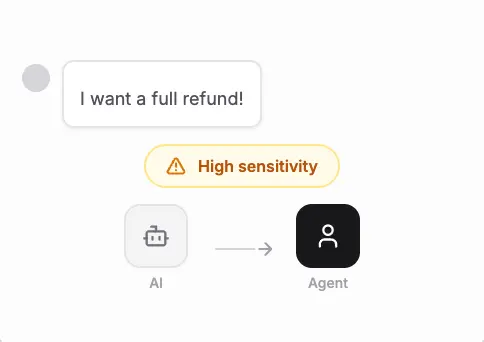
Smart Escalations: When an AI Agent Should Hand Over
When an AI agent should hand a conversation to a person: upset customers, questions it can't answer, sensitive topics and big buyers. How to set the rules
An AI agent should hand a conversation to a person in four situations: the customer is upset, the question needs an answer it doesn’t have, the topic is one a person must decide, or the person is a big buyer worth a human touch. Everything else, the routine questions with one right answer, it can handle on its own.
How it hands over matters as much as when. A good handoff tells the customer a person is coming, gives that person the whole conversation and the reason it was passed on, and stops the agent replying in the meantime. A cold transfer, where the customer has to start again, is worse than no agent at all.
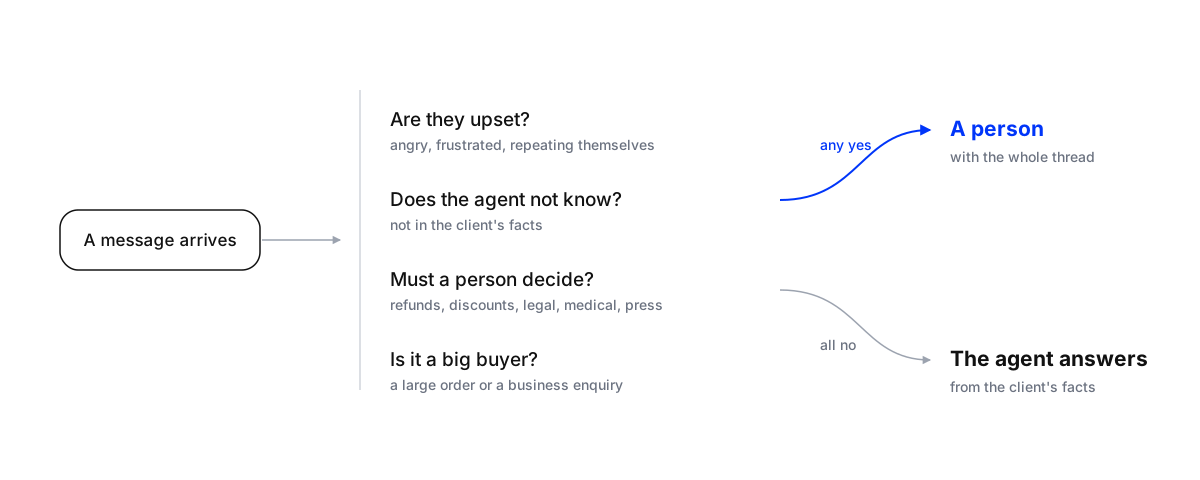
The four reasons to hand over
They’re upset. Anger, frustration, sarcasm, “this is the third time I’ve asked”. The agent can acknowledge it, but a person should reply. Upset customers want to be heard by someone who can do something.
It doesn’t know. The answer isn’t in the client’s facts, or the question is unusual enough that a guess would be risky. Saying “a person will confirm that” is always better than inventing an answer.
A person must decide. Refunds, discounts, exceptions, anything legal or medical, press enquiries, anything about a member of staff. These aren’t hard for an agent to answer; they’re not the agent’s to answer.
It’s a big buyer. A wholesale order, a corporate booking, a wedding for 200. The agent can gather the details, then a person should take it from there.
Write the rules per client
Each client draws these lines differently. A clinic sends anything about symptoms to a person; a restaurant sends large group bookings; a shop sends anything about a damaged order. Write the list with the client before the agent goes live, and test it on their real past messages to check every conversation that should reach a person does. How to run that test is in how to test an AI agent before it answers customers.
A handoff, not a cold transfer
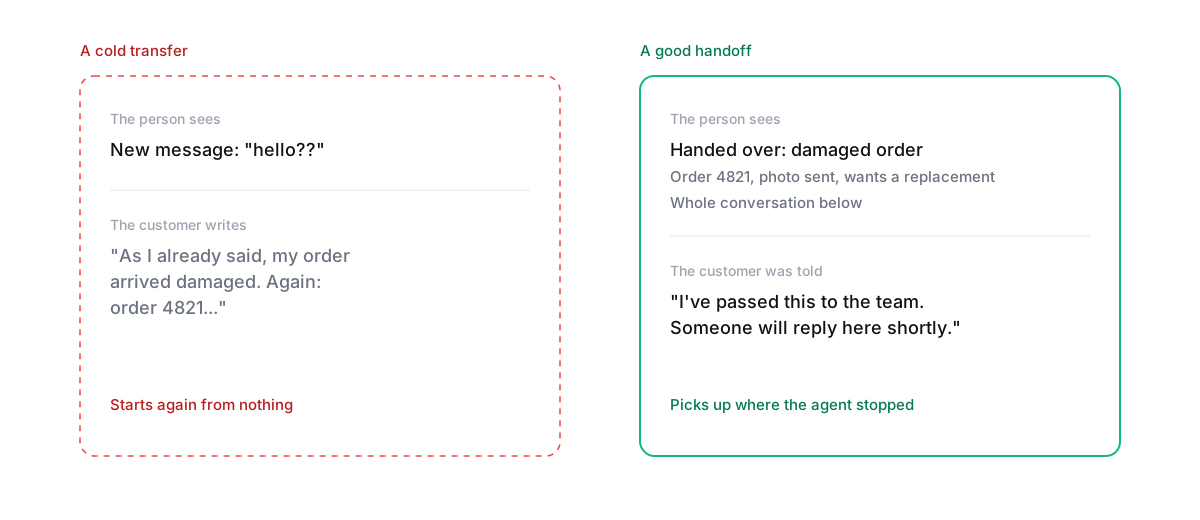
Three things make the difference:
- The customer knows. “I’m passing this to the team, someone will reply here shortly.” Honest, short, and it stops them asking again.
- The person has everything. The whole conversation, what the agent already said, and why it handed over.
- The agent steps back. Once a person is on it, the agent should stay quiet in that conversation, or the customer gets two answers. See avoid double replies.
Then someone has to actually reply. A handoff into an inbox nobody watches is the worst outcome: the customer was promised a person and got silence. Decide who picks up handoffs for each client, and how fast. If it’s outside working hours, the holding message should say when to expect an answer. On Instagram and Messenger, a person can still reply up to seven days later through Meta’s human agent permission, but the customer won’t wait that long happily.
Handing over in public comments
A complaint under a post or an ad is different from one in a DM, because everyone reading the thread sees what happens next. The safest rule is that a person writes the public reply to a complaint, even if the agent handles everything else. One calm, specific line in public (“Sorry about this, we’ve messaged you to sort it out today”), then the details in a private message. The agent’s job there is to spot the complaint quickly and get it in front of someone, not to answer it.
Handing back to the agent
Once a person has dealt with the issue, the conversation doesn’t need to stay with them forever. If the same customer comes back next week asking about opening hours, the agent can answer. In Maxbound, the agent pauses in a conversation for an hour after a team member replies, then picks up again if the customer writes later. That keeps people on the hard part without making every past complaint a permanent manual case.
Signs the rules need adjusting
Rules that are too tight send routine questions to people: the team spends its day answering opening hours that the agent could have handled, and the time to reply to real handoffs grows. Rules that are too loose let the agent answer things it shouldn’t: you’ll see it in the weekly review as replies about refunds, discounts or complaints that a person should have written. Read twenty handoffs and twenty unescalated conversations each week for the first month; the pattern shows quickly.
Set it up for a client
Set up escalation rules for a client's AI agent
- List the topics a person decidesRefunds, discounts, complaints, anything legal or medical, press, staff, and the client's own sensitive subjects.
- Define a big buyerWhat makes a conversation worth a human touch for this client: order size, group size, or a business enquiry.
- Write the holding messageWhat the customer is told when a conversation is handed over, including when to expect a reply outside working hours.
- Name who picks upA person for each client, how fast they reply, and who covers when they're away.
- Test on real messagesReplay past conversations and check every one that should reach a person does, and nothing else.
- Review handoffs weeklyLook at why each conversation was handed over. A question that keeps escalating is often a fact missing from the agent's knowledge.
Tune it over time
Watch two numbers per client. The share of conversations handed over should fall slowly as the agent learns the client’s facts, but never to zero: complaints and big decisions should always reach a person. And the time from handoff to a person’s reply should stay short. If handoffs keep growing, read them: most are a missing fact, which is fixed by adding it to the knowledge, not by loosening the rules. Sentiment analytics shows whether frustration is building in conversations nobody escalated.
Where Maxbound fits
Maxbound’s AI agents hand conversations to your team in one inbox with the full thread, so a person picks up where the agent stopped. Conversations that need attention are easy to filter, the agent pauses once a team member replies, and replies can wait for approval when you want a person to check everything. The rules differ per client, and each client has its own workspace. For agencies running paid social, see Maxbound for advertising agencies, and for approval-first setups, setting up a human-in-the-loop workflow.