AI vs Social Media Manager: Who Should Do What
AI won't replace a social media manager, but it does take over parts of the job. Which tasks to give AI, which to keep with a person, and how the role changes
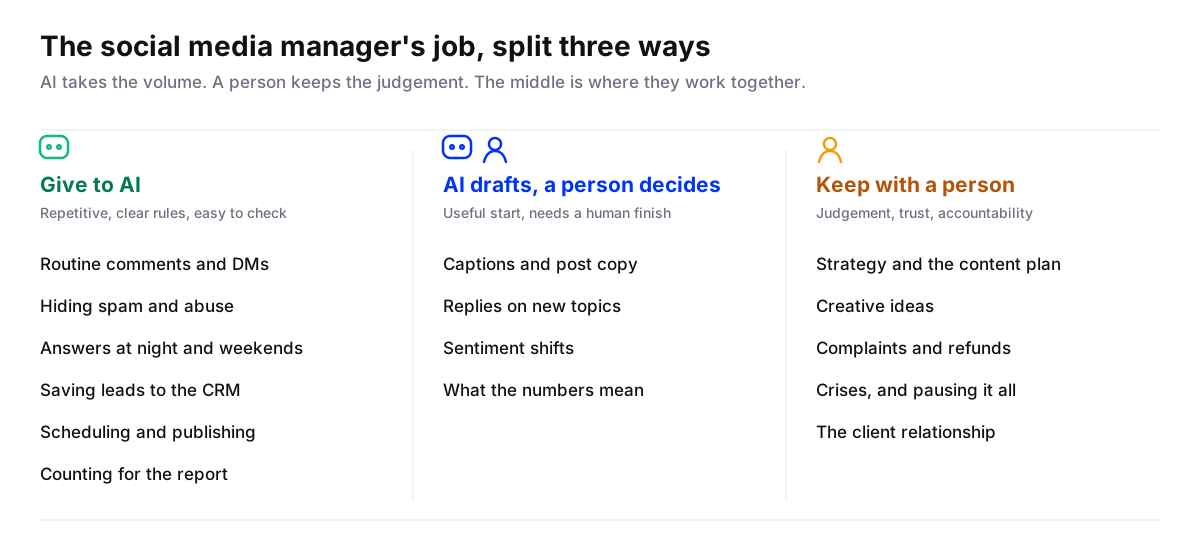
AI doesn’t replace a social media manager. It replaces parts of the job: answering the routine questions under posts and in DMs, hiding spam, scheduling, pulling the numbers together and writing first drafts. The parts that decide whether a client’s social works stay with a person: what to say and why, how the brand should sound, what to do when something goes wrong, and the relationship with the client.
So the useful question isn’t “AI or a person?” but “which tasks go where?”. Get that split right and one manager can look after more clients without the quality dropping. Get it wrong and you have either a person typing the same answer forty times a day, or a bot cheerfully replying to complaints during a crisis.
Task by task
What AI is good at
Volume and hours. A person can’t answer a comment at 2am, or the four hundredth “how much?” under a reel without their attention drifting. A good agent answers both, from the client’s own facts, in seconds.
That gap is real, including at agencies. When we read 1,788 public comments on the Instagram and Facebook posts of 178 businesses in the Middle East, the businesses had answered 15% of them in the thread. Marketing and advertising agencies answered 6% of the comments on their own posts, and 54 of the 62 agencies answered none (Maxbound comment response study). Busy people skip the comments, even when replying is their trade.
AI is also consistent. It applies the same rules on Friday night as on Monday morning, and it doesn’t get tired of hiding the same spam.
What still needs a person
Judgement, above all. Picture a client whose product has just been recalled. The scheduled posts keep going out on time, cheerful as planned, and an agent that has been told to be helpful keeps answering questions about the product as if nothing happened. Nothing technical went wrong. Nobody told the system the situation had changed. A person notices that in minutes.
That’s why every client needs a pause plan, agreed before anything goes wrong: who can stop the scheduled posts and the automated replies, how quickly, and who answers in their place. On a bad day the switch matters more than any setting.
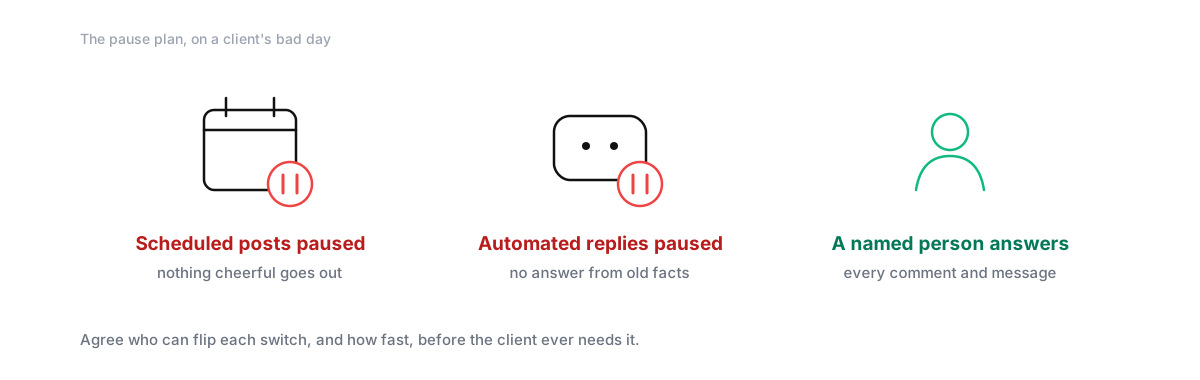
The same applies to tone in a sensitive thread, to a joke that lands badly in one market, and to knowing when a public reply should become a phone call. These aren’t edge cases. They’re the moments clients remember.
Drafting is the middle ground. Knak’s study of marketing production found that 88% of teams using AI still need moderate to substantial human editing. That matches what most teams see with captions and replies: the draft is useful, and it still needs a person before it carries the brand’s name.
| If the task involves | Keep it with a person because |
|---|---|
| Money moving: refunds, discounts, compensation | Mistakes cost the client directly |
| Anything legal, medical or about safety | The wrong answer can cause real harm |
| An angry customer in public | Thousands read the reply, not just the customer |
| A decision the client hasn’t made yet | The AI can only repeat what it was told |
How the role changes at an agency
When the routine replies move to an agent, the manager’s week changes shape. Less time in the inbox typing answers, more time on the work that was always being squeezed:
- Training and reviewing the agent. Loading each client’s facts, reading its drafts, correcting what’s wrong. In the first weeks this is real work; after that it’s a short daily review. How to set it up is in setting up a human-in-the-loop workflow.
- Reading what people are saying. Sentiment analytics shows which topics are rising and where frustration is building, and the manager decides what to do about it.
- Handling what the agent hands over. Complaints, big deals and anything sensitive arrive with the whole conversation attached.
- Strategy, ideas and the client. The parts of the job that win and keep retainers.
The skills that matter shift a little too: writing clear rules for what the agent may answer, reviewing quickly, and knowing each client’s business well enough to spot a wrong answer.
Moving tasks to AI, one at a time
Hand parts of the social media job to AI
- Log a normal weekFor one client, note what the manager actually spends time on: replies, moderation, scheduling, reporting, drafting, strategy, client calls.
- Pick the most repetitive taskUsually answering routine comments and DMs. It's the most hours, the clearest rules and the easiest to check.
- Write the rulesWhat the AI may answer, what it hands to a person, and what it hides. Agree them with the client.
- Start with draftsHave the AI draft and the manager approve or edit for a week or two. Edits teach the AI the brand's voice.
- Let routine answers go out aloneOnce drafts are consistently right, let the AI send routine answers on its own. Keep sensitive topics with a person.
- Agree a pause planDecide in advance who stops scheduled posts and automated replies if the client has a crisis, and how fast.
- Move to the next taskOnly when the first one runs well. Reinvest the saved hours in strategy and the client.
The pause plan is the step teams skip, and it’s the one that matters on a client’s worst day. For night and weekend coverage, see 24/7 social media replies.
Is it cheaper?
Count hours, not salaries. For each client, multiply the replies the AI handles in a month by the minutes a person used to spend on each, and compare that with what the tool costs for that client. Then add what nobody was doing before, such as answers outside office hours, which is often the bigger gain. The saving rarely means fewer people; it usually means the same people looking after more clients, or doing better work for the ones they have.
Where Maxbound fits
Maxbound is an AI operating system for agencies, built for the “give to AI” and “AI drafts, person decides” rows. Its AI agents answer comments and DMs on Instagram and Facebook, plus WhatsApp, website chat and in-app chat, trained on each client’s own material, and hand anything that needs judgement to your team in one inbox. Comment moderation answers, hides or escalates each comment, and scheduling publishes to Instagram, Facebook, TikTok and YouTube from the same workspace. Each client has its own workspace and report. Strategy, ideas and the client relationship stay with your people.