5 Iraqi Arabic Ad Comment Myths and What Is True
Can AI answer Facebook and Instagram ad comments in Iraqi Arabic and Sorani Kurdish? Five myths agencies believe, and how dialect replies actually work.
Can AI agents answer Meta ad comments in Iraqi Arabic?
Yes. An AI agent can answer prospect questions on Facebook and Instagram ad comments automatically, in Iraqi Arabic or Kurdish (Sorani), in the commenter’s own dialect. In Maxbound, each client’s agent is briefed in plain language, answers from that client’s own website, files, FAQs and past chats, and can keep every reply as a draft for a person to approve until the agency trusts it.
Speed on ad comments affects reach as well as sales. Ajala Digital reports that engaging with comments can increase your ad’s visibility by up to 50%, so an unanswered thread costs a client twice: the lead and the delivery.
Why are Iraqi ad comments so hard to answer by hand?
Picture a normal week on Instagram ads in Iraq. The ad goes live. Comments pile up in Baghdadi Arabic, some in Sorani, some in English, some a mix of all three.
The agency’s team writes good copy. They often don’t write Iraqi dialect. So the comments sit, or get a stiff formal reply that reads like a press release.
The manual benchmark is tough even in one language. Ajala Digital suggests checking ad comments at least twice daily during active campaigns and answering legitimate complaints within one to two hours in business hours. Now multiply that by every client, every ad set, and two or three languages.
That’s the pain. Not a lack of effort. A lack of hours and dialects.
The Language, Intent, Venue check
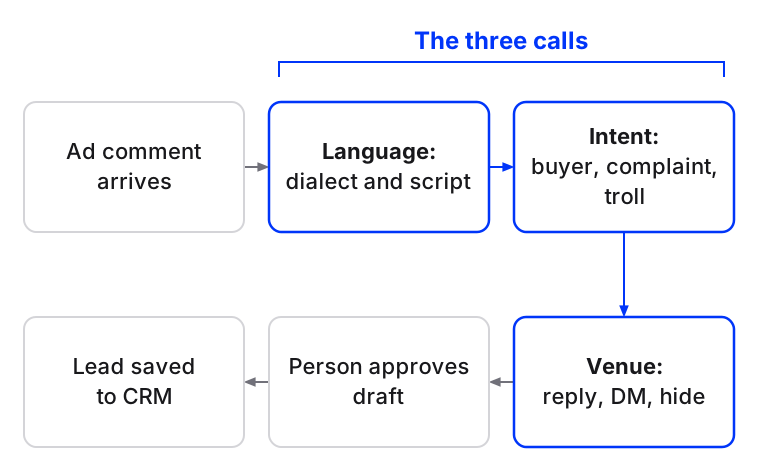
Most advice on Arabic dialect AI replies stops at language. Language is only the first of three calls an agent makes on every ad comment.
-
Language: which dialect and script did the commenter use, and what are they actually asking?
-
Intent: is this a buyer, a complaint, a troll, spam, or a rival’s pitch?
-
Venue: should the answer go in the public thread, in a private DM, or nowhere because the comment gets hidden?
Get language right and the other two wrong, and you’ve posted a perfectly worded price in a public thread a competitor can screenshot. Every myth below breaks on one of these three calls.
Five myths about Arabic dialect AI replies on ad comments
Myth 1: AI only understands Modern Standard Arabic
Reality: Iraqi Arabic is its own spoken system, and an agent has to read its grammar, not just its vocabulary.
Small markers change what a comment means. The Yallah Speak guide to Iraqi Arabic notes that the da- prefix marks something happening right now and the raah prefix marks the future. “Is it arriving?” and “Will it arrive?” are different questions for a delivery business.
Maxbound agents answer in the customer’s own language, including Iraqi Arabic and Kurdish (Sorani). A Sorani comment gets a Sorani reply. An English comment gets English.
Myth 2: A formal Arabic reply is the safe default
Reality: A formal reply to a dialect question reads like it came from a head office, not the shop the person wants to buy from.
Match the commenter. If a client wants one house default for Arabic replies, Baghdadi is a sensible choice: the same Yallah Speak guide calls it the most widely understood variety in Iraq.
Tone matters as much as dialect. Maxbound agents learn each brand’s tone of voice and improve from the edits your team makes, so a playful fashion brand and a clinic in Erbil don’t end up sounding the same.
Myth 3: Meta’s keyword filter is all the moderation you need
Reality: Meta’s filters match lists. They don’t read intent.
As Coegi explains, Meta lets a page block up to 1,000 keywords and offers a profanity filter with two sensitivity levels, medium and strong. Turn both on. But a list misses an insult spelled three different ways, written in Latin letters, or phrased politely. A list also can’t tell a rival’s sales pitch from a genuine question.
Maxbound’s comment moderation hides spam, abuse and rival pitches from every post and ad in the client’s workspace, judged on what the comment means rather than the words it happens to contain.
Myth 4: The agent should answer the whole question in the comment
Reality: Venue decides whether a good answer helps or hurts. Price, stock, delivery to a specific area, phone numbers: these belong in a DM.
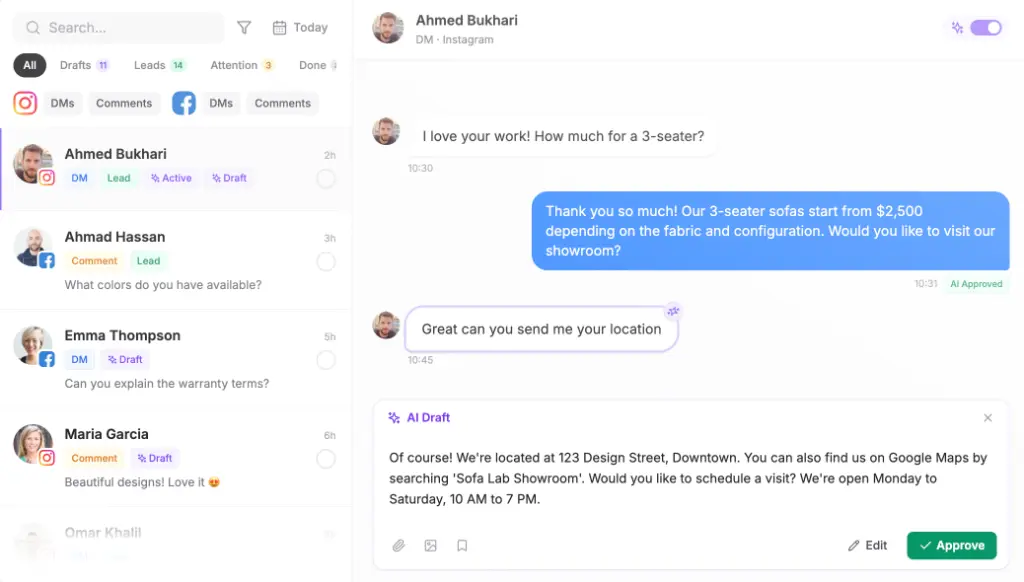
Instagram comment to DM automation works like this in Maxbound: the agent posts one short public reply, sends the full answer privately, and saves the commenter as a contact in the CRM with the details from the conversation. Nobody types the lead in. Real buyers get routed to the client’s team and the rest get followed up.
Myth 5: You switch the agent on and hope for the best
Reality: You rehearse it first, then run it with approval on.
Maxbound Simulations rehearse an agent on real past conversations before it answers anyone. That’s how a paid social team tests replies on last campaign’s comment threads, dialect ones included, before the next ad launches. You see what the agent would have said, fix the brief, and run it again.
After go-live, the agent can draft each reply for a person to approve or edit before it’s sent. Approval can stay on for as long as the agency wants.
What should each type of ad comment get?
Use this as the intent and venue half of the brief. Copy it into your client onboarding doc.
| Comment intent | Venue | What the agent does |
|---|---|---|
| Price or stock question | Short public reply, then DM | Sends details by DM, saves the contact |
| Clear buying signal | DM | Qualifies, hands to a person with history |
| Complaint | One public acknowledgement, then DM | Drafts for approval, escalates to the owner |
| Praise | Public | Short thank-you in the commenter’s dialect |
| Abuse or troll | Hidden | Moderation hides it, no reply |
| Spam or rival pitch | Hidden | Moderation hides it, no reply |
How do you reply to Instagram comments on Iraqi ads with an agent?
You connect the client, train the agent on the client’s sources, brief it in plain language, rehearse, and go live with approval on. The steps below are the whole setup for one client workspace.
Set up dialect ad comment replies for one client
- Connect the client's accountsSend the client a one-time Magic Link. They authorise their own Instagram and Facebook accounts through the official login. Maxbound never asks for, sees or stores a password.
- Train the agent's knowledgeAdd the client's website, price files, FAQs and past chats so answers come from the client's own sources.
- Brief the agentPaste the brief template below, filled in for the client. The agent asks what it still needs, then builds the setup and waits for approval.
- Rehearse in SimulationsRun the agent against real past ad comment threads, including Iraqi Arabic, Sorani and mixed-language ones. Fix the brief where replies miss.
- Go live with approval onKeep every reply as a draft for a person to approve or edit. The agent learns the brand's tone from those edits.
- Review the client's analyticsCheck reply times, leads and what people asked for that client, then decide whether to loosen approval.
Here’s a brief you can copy. Write it in English; the agent replies in the commenter’s language.
For [Client]‘s Facebook and Instagram ad comments: reply in the commenter’s own language and dialect. Iraqi Arabic gets Iraqi Arabic, Sorani gets Sorani, English gets English. Keep public replies to one short sentence and never post a price publicly. For price, stock or delivery questions, send the details by DM and save the contact. For complaints, acknowledge once in public, move to DM, and hand the conversation to [Name] with its history. Hide abuse, spam and competitor pitches. Keep every reply as a draft for approval until I say otherwise.
When shouldn’t you automate dialect ad replies?
I wouldn’t switch a brand-new client straight to autonomous replies. With no past conversations and thin knowledge, keep drafts on and let the edits teach the agent first.
Keep approval on for complaint-heavy or sensitive categories too, like healthcare, where one wrong public sentence is expensive.
Be clear on what Maxbound doesn’t cover. Maxbound has no voice, SMS or Slack agent, so voice notes and phone calls stay with people. Conversations run on WhatsApp, Instagram, Facebook, website chat and in-app chat, and posts publish to Instagram, Facebook, TikTok and YouTube only. Maxbound also doesn’t publish dialect accuracy scores, which is exactly why Simulations exist: test on your own client’s comments, not on someone’s benchmark.
Where Maxbound fits
Maxbound fits advertising agencies running ad accounts for several clients across Iraq and Kurdistan, where the comments arrive in more dialects than the team writes. Each client gets its own workspace, with its own channels, knowledge, contacts and agents, and nothing crosses between clients. A workspace that works can be cloned for the next client.
It’s priced per workspace with AI credits included, and every account starts with a 7-day free trial. Brief one client’s ad comments this week, rehearse it on last month’s threads, and see what the agent would have said.