How to Answer Instagram DMs in Arabic for Clients
A step-by-step playbook for agencies: connect, train and brief an agent for Arabic Instagram DM replies and comment-to-DM, dialects and spelling variants
To answer Instagram DMs in Arabic for a client, connect the client’s Instagram Business or Creator account through Meta’s official login. Train an agent on the client’s own sources, and brief it to reply in the dialect each customer writes in. Then rehearse it on the client’s real past Arabic conversations and keep a person approving replies until the answers read right.
Keyword lists alone break on Arabic, because one question arrives in many spellings and several dialects. Maxbound handles every step inside the client’s own workspace: the Instagram connection, the knowledge, the agent, the comment-to-DM automation and the approval queue.
Why do Arabic Instagram DM replies break standard automation?
Arabic Instagram DM replies break standard automation because most tools match exact words, and Arabic speakers don’t type one exact word. The same customer question can arrive with or without the definite article, with or without diacritics, and with different forms of the same letter. Hamza on the alef, the final taa marbuta written as a plain haa, and the dotted or undotted final yaa all produce what software treats as different words.
The matching rules don’t forgive any of this. Instagram comment matching ignores upper and lower case, but it treats every spelling as a different word. So a keyword list built from the standard spelling misses the people who type the way they talk.
Then there’s dialect. An Iraqi customer asks “how much” differently from a Gulf customer, an Egyptian customer or a Levantine one. Plenty of younger customers write Arabizi, Arabic words in Latin letters with numerals standing in for sounds English doesn’t have. Others mix Arabic and English in a single line.
Two technical details catch agencies too. Right-to-left text mixed with prices, phone numbers or English product names can display out of order, so a reply that looked fine in the editor can read scrambled on a phone. And message text sent through the API has to be UTF-8 and no more than 1,000 bytes.
What do you need before you start?
You need five things in place before you touch a single setting:
-
A Business or Creator account. Personal Instagram accounts can’t run auto-replies. The client’s account has to be Business or Creator and linked to a Facebook Page.
-
The client’s own sources. Website, price lists, delivery terms, FAQs and product names written exactly as they appear in post captions.
-
Past conversations. A few weeks of real Arabic DMs and comments, so the agent learns how this client’s customers actually write.
-
A lead owner. One named person at the client or the agency who gets qualified leads and hard cases.
-
A dialect decision. Which dialect the brand replies in by default, and whether it mirrors the customer.
How to set up Arabic Instagram DM automation, step by step
The setup below runs in seven steps. Each step happens inside the client’s workspace, so nothing you build for one client touches another.
How to answer Instagram DMs in Arabic for a client
- Connect the account by Magic LinkSend the client a one-time Magic Link so they authorise their Instagram Business or Creator account through Meta's official login. No password is shared.
- Map the dialectsRead the client's past DMs and comments and list the dialects, Arabizi spellings and mixed Arabic-English phrases customers use.
- Train the agent's knowledgeTrain the agent on the client's website, price lists, FAQs and past chats, using product names exactly as written in captions.
- Brief the agent in plain languageTell the agent which dialect to default to, when to mirror the customer, what it may promise and when to hand over to a person.
- Set up Arabic comment-to-DMDescribe which comments should get a DM and what the DM says, and let the agent read intent instead of matching one spelling.
- Rehearse with SimulationsRun the agent against real past Arabic conversations and fix every answer that reads wrong before it replies to anyone.
- Go live with approval onKeep drafts waiting for a person's approval, check them daily, and only loosen approval for question types that come back clean.
Step 1: Connect the client’s Instagram by Magic Link
Send the client a one-time Magic Link and they authorise their own Instagram account through Meta’s official OAuth login. Maxbound is an approved Meta Tech Provider, so it never asks for, sees or stores the client’s password. That matters more than it sounds: password-sharing tools are what get accounts flagged, and an official API connection is the safe route every serious tool now takes.
Step 2: Map how the client’s customers actually write
Open the past conversations and sort them by how people write, not by topic. Note the dominant dialect, how often Arabizi shows up, which English words get mixed in, and how customers write the client’s product names. If the client sells in Iraq, expect Iraqi Arabic; Maxbound agents answer in the customer’s own language, including Iraqi Arabic and Kurdish (Sorani).
Step 3: Train the agent on the client’s own sources
Add the website, price lists, FAQs and past chats through knowledge training. Use product names and codes exactly as they appear in captions, because customers copy what they see in the post. An agent working from the client’s sources answers the price question with the real price, not a guess.
Step 4: Brief the agent in plain language
Brief the agent the way you’d brief a new hire on the client’s account. The agent asks what it needs to know, then builds the setup and waits for approval. A brief you can copy and adapt:
You answer Instagram DMs and comments for [client]. Reply in Arabic script, in the same dialect the customer used. If they write Arabizi, reply in Arabic script. If they write in English, reply in English. Keep replies short: two or three lines, one question at the end. Prices, delivery times and stock come only from the price list and FAQ. Never promise a discount. If someone complains, asks for a refund or asks for a manager, hand the conversation to [owner] with its history. Save anyone who asks for a quote to the CRM, tagged Quote.
Step 5: Set up Arabic comment-to-DM
Instagram comment-to-DM automation sends a private message to someone who comments on a post or ad. For Arabic, the choice that decides whether it works is how the trigger reads the comment.
| Situation | Agent that reads the comment | Exact keyword trigger |
|---|---|---|
| Standard spelling of “price” | Replies | Replies |
| Same word with the definite article or a different letter form | Replies | Only if that spelling is listed |
| Iraqi or Gulf way of asking “how much” | Replies | Only if that phrase is listed |
| Arabizi in Latin letters | Replies | Only if that spelling is listed |
| Question with no keyword at all | Replies if the intent is clear | Misses it |
If you do use keywords, list every form your audience types, without diacritics. Whatever the trigger, two Meta rules apply. Meta allows one private reply per comment, within seven days of it, and once the person replies you have 24 hours from their last message to keep going. Say the keyword in the video and in the first line of the caption too, so commenters know what to type.
In Maxbound, the comment-to-DM-to-CRM workflow is briefed in one sentence, for example: “When someone asks the price under the sofa ad, in any spelling, DM them the price list and save anyone who asks for a quote.” For the reply mechanics themselves, our guide on how to reply on instagram dm covers the basics.
Step 6: Rehearse with Simulations before anyone sees a reply
Run the agent through Simulations on real past conversations from the client’s own inbox. Read every Arabic answer for three things: right dialect, right facts, and correct display when Arabic sits next to a price or an English name. Fix the brief or the knowledge, then run it again. Nothing reaches a customer during this step.
Step 7: Go live with approval on
Set the agent to draft replies that need a person’s approval before anything is sent. Someone at the agency who reads Arabic checks the drafts, edits what’s off and approves. Agents learn each brand’s tone of voice from those edits, so the drafts get closer to how the brand talks.
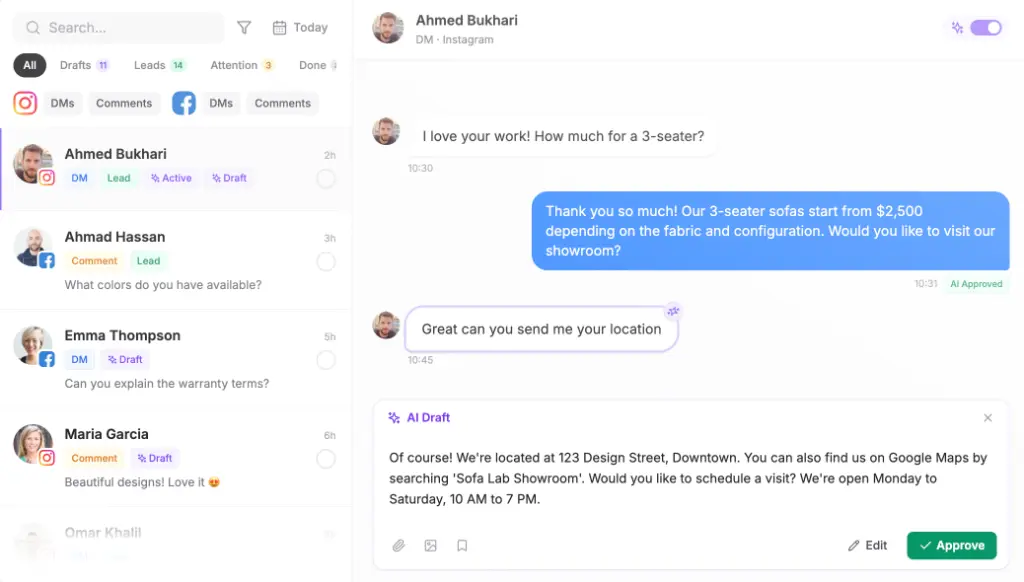
When a conversation needs a person, such as a complaint, a refund or a custom order, the agent hands it over with its full history, so the person doesn’t ask the customer to repeat themselves.
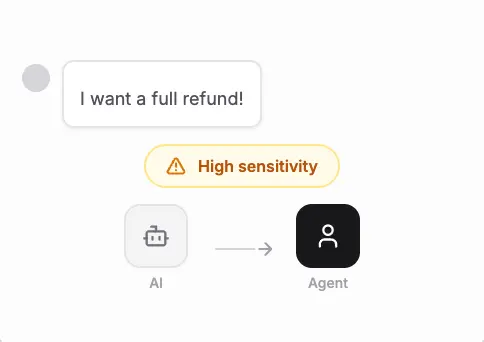
Approval can stay on for as long as the agency wants. A sensible rule: loosen it only for the question types that came back clean for a full week, like price and delivery, and keep complaints on approval permanently.
How do I set up comment-to-DM lead capture with a built-in CRM?
To set up comment-to-DM lead capture with a built-in CRM, brief the comment trigger, the DM and the save rule together, so each comment that turns into a conversation becomes a saved contact. In Maxbound the built-in CRM saves the lead’s details from the conversation itself: name, what they asked, the tag you chose and the owner. Nobody types it in.
The order matters. Comment on the post or ad, private DM with what was promised, one qualifying question, then save. Leads who don’t reply get one follow-up the next day and then stop. Everything stays inside the client’s workspace, so one client’s leads never mix with another’s.
Compared with a ManyChat-style Instagram DM automation flow built from keyword triggers, the difference for Arabic is the trigger and the save. A flow you build matches the spellings you listed; an agent that reads the comment handles the ones you didn’t, and the CRM entry comes from the same conversation.
What are Meta’s rules for Arabic DM automation?
Meta’s rules for Instagram DM automation apply the same way in Arabic as in English, and a few of them shape how you write the replies.
For most customer actions, the messaging window is 24 hours, so a lead who messages at night has to get an answer before the window closes, which is exactly when an agency team is offline.
| Rule | What it means for an Arabic setup |
|---|---|
| 24-hour window for most actions | Answer night messages without waiting for the morning shift |
| Up to 7 days after a Click-to-Direct ad message | Ad leads give you longer, but don’t rely on it |
| One private reply per comment, within 7 days | Make the first DM count; no second nudge from the same comment |
| UTF-8, 1,000 bytes or less per message | Arabic replies must stay short |
| Requests inactive for 30 days aren’t returned by the API | Clear the client’s Requests folder before you connect |
| No group messaging | Agents answer one-to-one DMs only |
Which mistakes break Arabic DM replies most often?
-
Building the keyword list from the standard spelling only. Customers type the way they speak.
-
Translating English replies. A translated reply reads stiff. Brief the agent in the dialect you want and let it write.
-
Long replies. Long Arabic replies hit the byte limit and lose readers on mobile anyway.
-
Skipping a display check. Arabic next to prices and English names can render out of order. Read the reply on a phone.
-
Turning approval off on day one. I wouldn’t try this on new clients. Keep a person in the loop until the drafts need almost no edits.
-
No named owner. A qualified lead with no owner is a lead lost.
What does Arabic Instagram DM automation cost?
Maxbound is priced per workspace, one per client, with every feature in every workspace and 100 AI credits a month included. The price per workspace falls as an agency adds more, and every account starts with a 7-day free trial; there’s no free plan. Some locally priced tools charge by reply volume instead: Roddely’s starter plan, for example, is 999 EGP a month for up to 1,000 customer replies. See Maxbound pricing for the current per-workspace rates.
When is this the wrong setup?
If a single creator wants one keyword that drops one link, a simple Instagram DM automation tool will do the job for less. Maxbound fits agencies running Arabic-speaking clients across Instagram, WhatsApp, Facebook, website chat and in-app chat, where each client needs its own knowledge, its own inbox and its own approval queue. Maxbound doesn’t run voice or SMS agents, and it publishes posts only to Instagram, Facebook, TikTok and YouTube.
For marketing agencies running clients across the region, the payoff is simple. Start with one client, one post and approval on.